- Home
- Products
- About Us
- Resources
- Support
- Contact Us
Leave Your Message
-
Phone
-
E-mail
-
Whatsapp
-
WeChat


Engineered to simulate the harshest Middle Eastern environmental extremes, from severe desert solar radiation to accelerated chemical degradation.


Navigating the Kingdom's hyper-growth: How simulated environmental stress testing drives quality, safety, and regulatory compliance.
The Kingdom of Saudi Arabia (KSA) is undergoing an unprecedented economic and industrial metamorphosis under the strategic framework of Saudi Vision 2030. Rapid industrialization, mega-infrastructure ventures such as NEOM, the Red Sea Project, and Qiddiya, alongside the expansion of petrochemical corridors in Jubail and Yanbu, have radically transformed testing protocols. Operating environments in Saudi Arabia present severe climatic challenges: ambient temperatures often soar beyond 50°C (122°F), accompanied by aggressive ultraviolet (UV) radiation, severe particulate and sandstorm abrasion, and severe coastal humidity fluctuations along the Arabian Gulf and Red Sea.
Consequently, off-the-shelf industrial hardware, electronics, construction composites, and renewable energy assets face rapid thermal fatigue and early mechanical failure if not rigorously validated. Specialized environmental test chambers act as an indispensable scientific safeguard. By recreating acute cycles of hyperthermic stress, cryogenic dips, high humidity, photochemical degradation, and cyclic corrosion, manufacturers can verify that their materials and finished goods achieve operational resilience across decades of field deployment.
Compliance with the Saudi Standards, Metrology and Quality Organization (SASO) is essential for any industrial product imported into or manufactured within the Kingdom. SASO technical regulations enforce exacting safety, reliability, and emission criteria across building materials, automotive components, consumer electronics, and high-voltage power networks. Employing advanced climatic test systems ensures that local producers and global suppliers satisfy the Saber electronic platform verification protocols without delay.
The applications for climate simulation testing span the entire economic spectrum of modern Saudi Arabia:
1. Solar PV and Renewable Clean Energy: Under the National Renewable Energy Program (NREP), gigawatt-scale solar installations are being deployed across vast arid plains. Environmental test chambers evaluate solar photovoltaic modules and high-capacity battery energy storage systems (BESS) against UV embrittlement, thermal cycle shock, and cyclic sand-dust ingress to avert premature degradation.
2. Oil, Gas, and Petrochemical Infrastructure: Key entities such as Saudi Aramco and SABIC rely on continuous qualification of pipeline coatings, elastomer seals, industrial valves, and telemetry sensors exposed to aggressive hydrogen sulfide atmospheres, high pressure, and alternating desert heat.
3. Aerospace, Defense, and Automotive Assembly: As Saudi Arabia expands domestic defense procurement and establishes electric vehicle (EV) manufacturing hubs like Ceer Motors and Lucid Motors in King Abdullah Economic City (KAEC), thermal-shock, burn-in, and structural vertical impact testing become vital for critical automotive subsystems.
4. Sustainable Green Architecture: Stringent green building mandates enforce strict volatile organic compound (VOC) limitations. Formaldehyde emission chambers ensure interior building materials and architectural components meet both international and local health safety benchmarks.
Tailored engineering enhancements designed specifically to handle regional installation conditions in Riyadh, Dammam, and Jeddah.
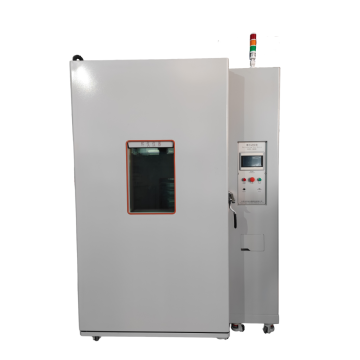
Equipped with dual-stage semi-hermetic or scroll compressor systems engineered with enhanced condensers, maintaining stability even when ambient machine-room temperatures rise to 45°C.
Equipped with intelligent microprocessors and touchscreen HMIs that optimize thermodynamic output, reducing power consumption during prolonged multi-day burn-in trials while logging real-time audit data.
Fabricated using laser-welded SUS304 or optional SUS316 stainless steel to resist salt fog, chemical condensation, and high humidity, preventing internal cabinet oxidation during continuous operation.
Delivering dependable testing validation across essential economic sectors in the Middle East and worldwide.


A trusted manufacturing partner for high-precision environmental simulation technology.
Dongguan Huanyi Instruments Technology Co., Ltd. was established on March 20, 2007, covering an area of 6,022 square meters. It is a high-tech enterprise integrating R&D, production, sales and after-sales service. It participated in the drafting of national standards and industry standards for environmental simulation test equipment.
Our philosophy is "customer-centric, quality-guaranteed, honesty-based, and innovation-oriented". Through unremitting efforts, Huanyi has cultivated a high-quality team with rich production, R&D and management experience. Since its establishment, the company has been providing customers with the "most competitive" products, continuously introducing international advanced technologies, learning from others and integrating them.
Year Established
Modern Manufacturing Hub
National Drafting Contributor
Turnkey Export to GCC & KSA


Ensuring compliance, seamless sea transport, on-site commissioning, and reliable technical backup for Saudi enterprises.

(1) Meeting to confirm customer needs and technical scope specifications.

(1) The product development team develops and improves products according to customer needs.

(1) Welding process
(2) Paint baking process
(3) Equipment assembly
(4) Equipment debugging

(1) Quality control
(2) Software debugging/Data calibration
(3) Visual/Internal inspection
(4) Equipment ready for dispatch

(1) Wood case package export-grade standard
(2) Package to container
(3) Safe container loading for oceanic transit

(1) Fault repair
(2) On-site inspection service
(3) Provide solutions
(4) Continuous telephone and online follow-up
Explore our complete spectrum of climatic, environmental aging, air purification, and impact testing equipment.