



High and Low Temperature Thermal Stream System: Accurate Temperature Control Solution for Semiconductor Reliability Testing
I. Temperature Control Challenges in Semiconductor Testing
In the semiconductor and optical communication fields, the environmental reliability of products directly affects their stable performance under complex operating conditions. Chips, power devices, optical modules, and other components often need to withstand rapid temperature changes and continuous thermal stress during service. Traditional testing equipment struggles to meet the demands of high-frequency, high-speed testing in terms of temperature change rate, temperature control accuracy, and airflow impact switching speed, creating a technical bottleneck for accurately assessing product thermal characteristics.
Semiconductor companies face three main challenges when conducting reliability verification: how to achieve accurate local temperature control, how to quantify heat flux density and junction temperature fluctuations, and how to perform charged testing within a confined space. These demands have driven the iterative upgrade of high and low temperature heat flux meter technology, requiring equipment not only to have rapid response capabilities but also to provide accurate temperature field control and thermal characteristic analysis functions.
II. Key Value of Thermal Stream System Technology
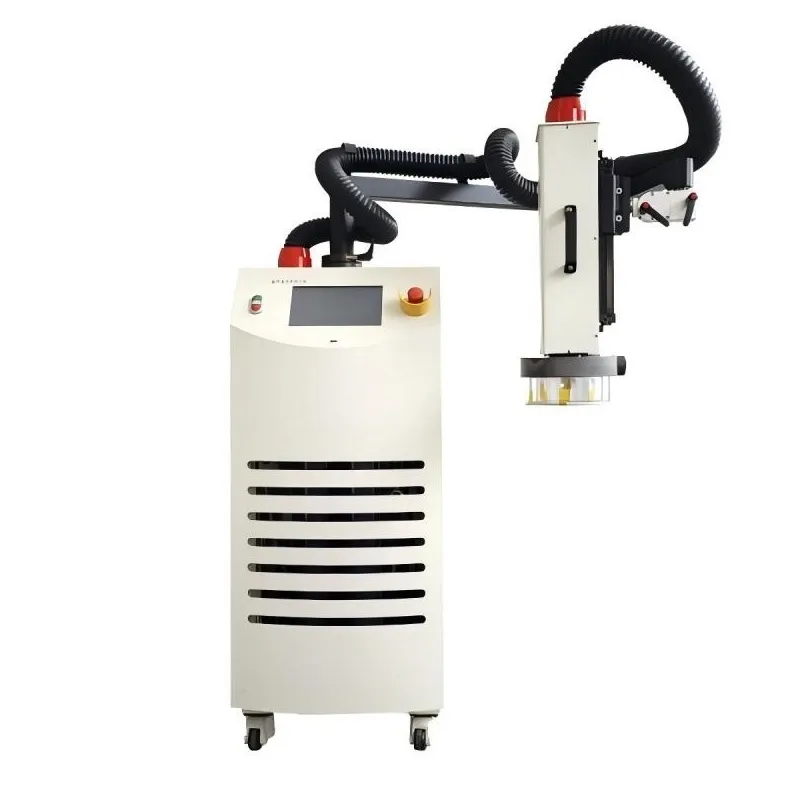
High and low temperature thermal stream systems are crucial equipment for environmental reliability testing, and their technological value lies in the integration of multi-dimensional testing capabilities. By directly contacting the surface of the object under test with the hot head, the equipment can achieve accurate local temperature control while simultaneously monitoring multiple parameters such as temperature, resistance, and heat flux density, providing quantitative data support for failure analysis.
III. Differentiated Product Solutions
1. Contact-Type High and Low Temperature Airflow Impactor
Addressing the needs of semiconductor, automotive electronics, and aerospace industries for rapid temperature impact on the surface of the tested object, the contact-type high and low temperature airflow impactor directly applies heat to the DUT surface through a hot head, achieving accurate local temperature control. This device can complete a cross-domain cooling from 125℃ to -50℃ within 10 seconds, with a temperature change rate of 17.5℃/s, meeting the stringent verification standards for chip-level reliability.
2. IGBT Test Thermal Stream System
During operation, junction temperature fluctuations in power devices directly affect their long-term reliability. The IGBT test thermal stream system accurately controls the temperature field and heat flux density, measuring key parameters such as thermal resistance, junction temperature fluctuations, and thermal stability, providing quantitative evidence for power device failure analysis.
This device solves the challenge of analyzing the thermal characteristics of power devices, helping companies identify potential risks during the design phase and shorten product verification cycles.
3. High and Low Resistance Test Thermal Stream System
The resistivity characteristics and thermal conduction behavior of materials over a wide temperature range have a complex coupling relationship. High and low resistance thermal stream systems enable simultaneous monitoring of temperature, resistance, and heat flux density, revealing the thermoelectric coupling properties of materials. This multi-parameter simultaneous analysis capability provides an important tool for new material development and device optimization.
4. Miniature Thermal Stream System
Addressing the need for conducting electrically conductive reliability tests on small components within limited space, miniature thermal stream systems support the testing of test specimens' electrical performance with an extremely small footprint. This space-optimized design is particularly suitable for the rapid screening of products such as optical modules and small sensors.
IV. Technological Evolution and Application Expansion
The application scenarios for high and low temperature thermal stream systems are continuously expanding. In addition to traditional semiconductor packaging reliability assessment, the demand for thermal characteristic analysis is growing in fields such as optical communication modules, new energy vehicle electronics, and aerospace components. Huanyi has also developed a matching automated chip sorting machine that can operate in a wide temperature range of -65℃ to +150℃, ensuring the stability of equipment in complex battlefield environments.
The combined application of the High Accelerated Stress Tester (Hast Chamber) and multi-temperature sorting equipment further improves the complete testing chain from accelerated aging to performance screening. By simulating extreme environments of high temperature, high humidity, and high pressure, it quickly identifies potential defects such as package cracking and metal corrosion, improving chip yield.
V. Industry Trends and Outlook
With the rapid development of 5G communication, artificial intelligence chips, and third-generation semiconductors, the performance requirements for environmental reliability testing equipment will continue to rise. Accurate temperature control, simultaneous multi-parameter measurement, and automated integration will become the main directions of technological development.
Advances in high and low temperature thermal stream system technology are driving the transformation of semiconductor reliability testing from qualitative assessment to quantitative analysis, providing stronger technical support for product quality improvement and innovative R&D.