





Optical Module Thermal Stream System
The optical module thermal stream systems is used for high and low temperature performance testing of optical modules. Since the performance of many components in an optical module is easily affected by temperature, including lasers, detectors, and drivers, the overall performance of the optical module is also affected by the ambient temperature. Therefore, high and low temperature performance testing of optical modules is an essential process to ensure the quality of optical modules during the manufacturing process.
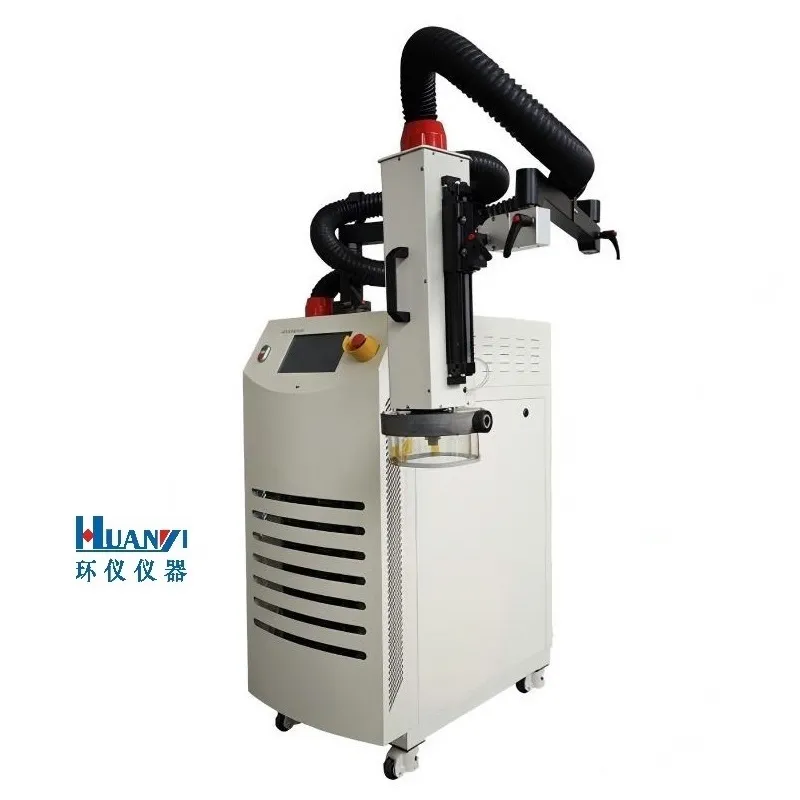
Technical parameters:
| Brand | Huanyi Instruments |
| Temperature Range | -80°C~+225°C |
| Temperature Accuracy | ±1.0°C |
| Temperature Overshoot | ≤1°C |
| Temperature Set Accuracy | 0.1°C |
| Stability | ≤0.5°C |
| Temperature Sensor Type | T-type thermocouple |
| Temperature Change Rate (No Load) | -55°C~+125°C, approx. 10s; +125°C~-55°C, approx. 15s; |
| Airflow Output | 5~16 SCFM adjustable |
| Heat Shield Dimensions | Φ140mm*60mm |
| Temperature Control Method | Air temperature and sample temperature switchable control |
| Supply Gas Pressure | 90Psi~110Psi (20°C ~28°C) |
| Supply Gas Flow Rate | 700L/min (25 scfm) |
Test Method:
Taking the high and low temperature test of industrial-grade optical modules as an example, it is necessary to test the performance of optical modules in environments of -40℃ and 85℃. In order to ensure production efficiency, optical modules are generally tested using a thermal stream systems.
Working Principle:
The thermal stream systems sprays high-temperature (low-temperature) compressed air directly onto the surface of the object being tested, causing the ambient temperature of the object to rise (fall) rapidly to the set temperature. Typically, it can raise the ambient temperature of the object from room temperature (25℃) to 85℃ within tens of seconds. Due to its high temperature change efficiency, it is widely used in high and low temperature testing of optical modules.
Product Features:
1. By designing a mounting base and testing platform, which can be aligned vertically, the airflow used for testing is guided to flow steadily downwards, maintaining a good flow path and ensuring stable airflow temperature near the optical module under test, achieving good testing accuracy and results.
2. The inclusion of a fan shroud, connecting base, and housing helps maintain a stable airflow path during downward flow, achieving good testing accuracy and results.
3. The fan shroud and baffle not only provide shielding, but also allow heat exchange during airflow as it passes through the gap between the baffle and the fan shroud. In low-temperature testing, this further hinders the transfer of external heat into the fan shroud; in high-temperature testing, it further hinders the transfer of internal heat to the outside, thus maintaining stable airflow temperature near the optical module under test and achieving good testing accuracy and results.