



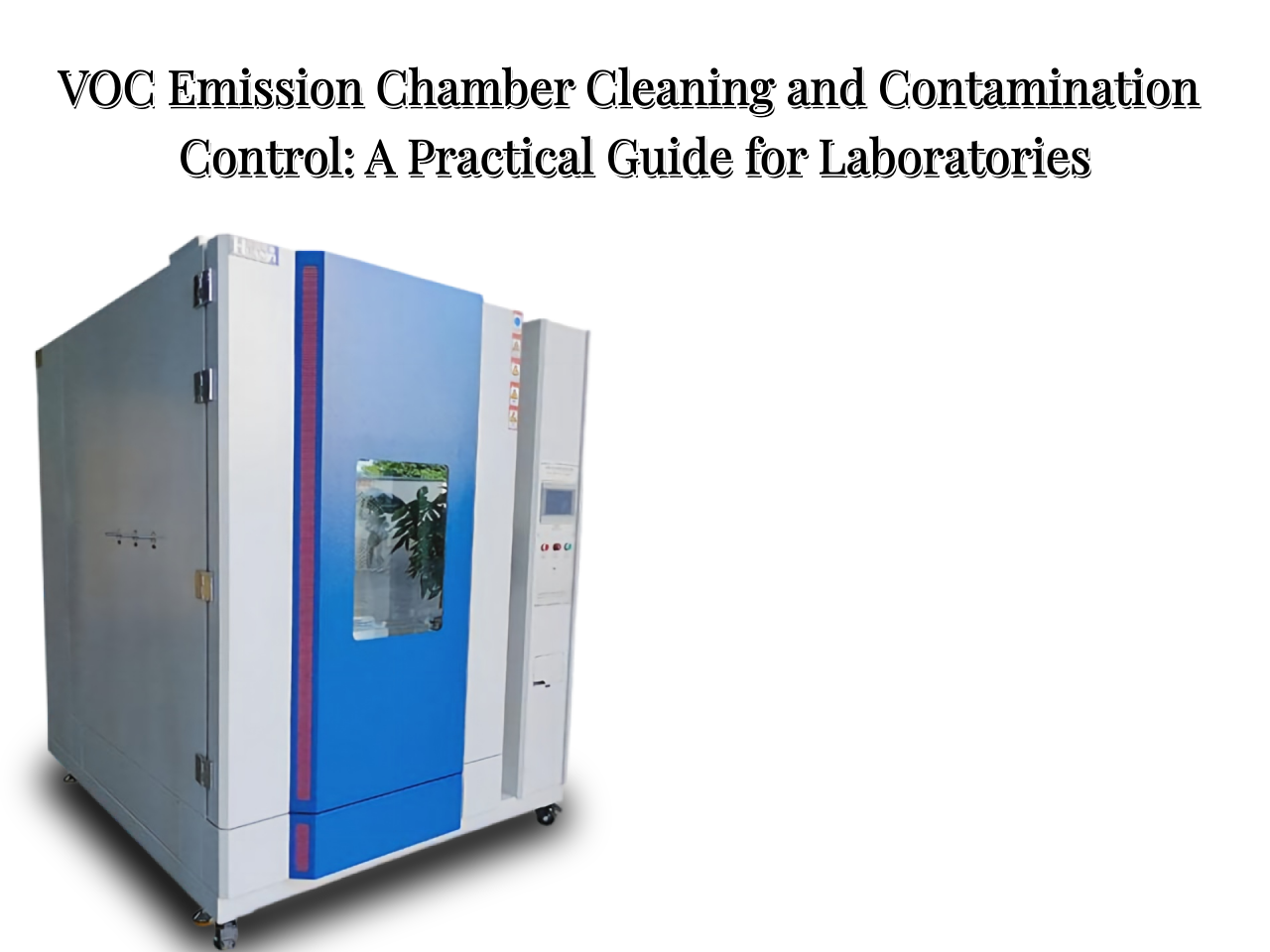
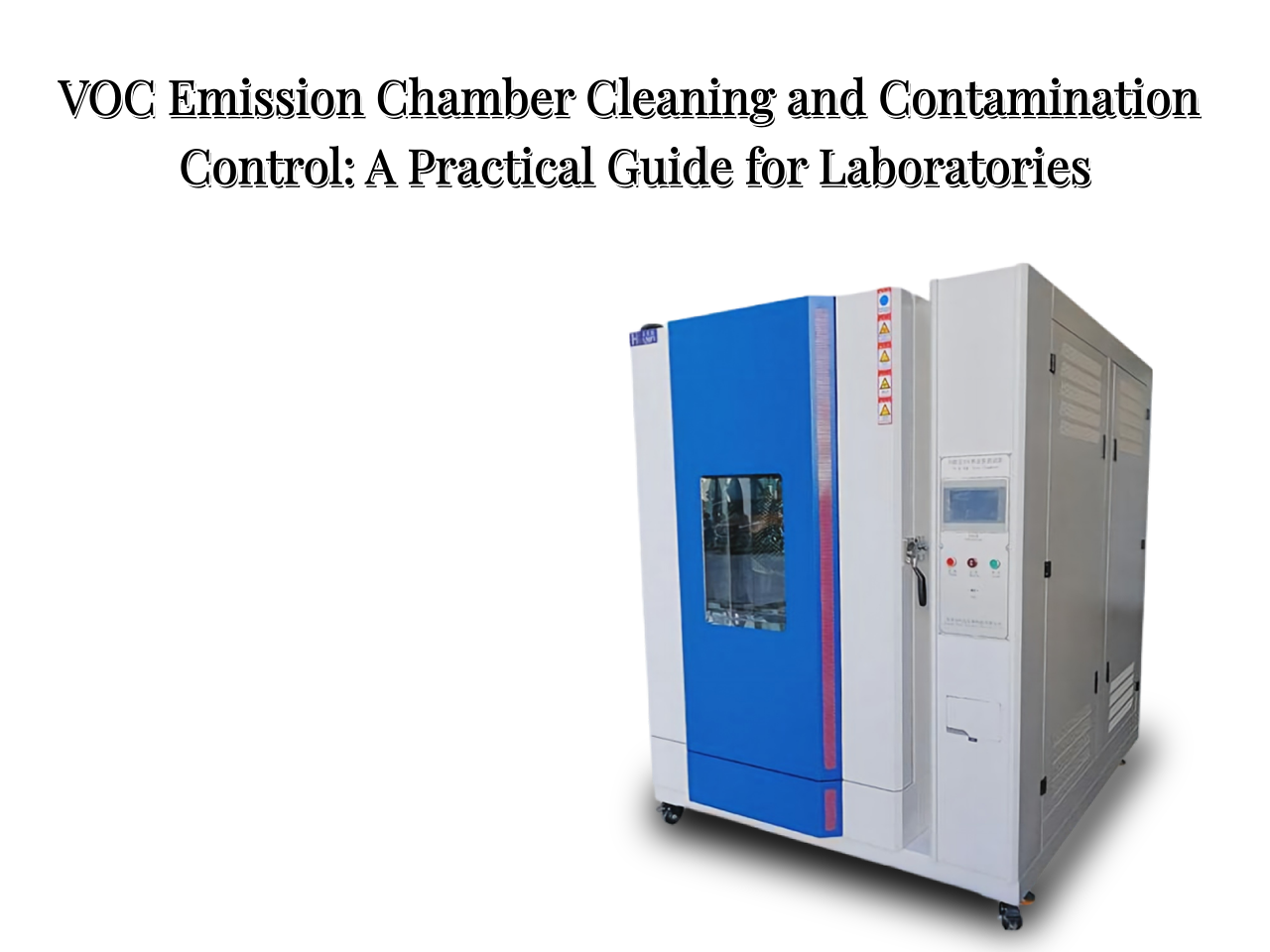
VOC Emission Chamber Cleaning and Contamination Control: A Practical Guide for Laboratories
Introduction
Reliable VOC emission testing requires more than stable temperature, humidity, and airflow. The cleanliness of the Environmental Chamber and its associated air-supply and sampling systems can also influence the quality of test results.
Residual compounds, contaminated air lines, unsuitable cleaning materials, and insufficient chamber conditioning may introduce unwanted background signals. These signals can complicate the interpretation of emissions from building materials, furniture, coatings, and other products.
For laboratories using a VOC chamber, a structured cleaning and contamination-control procedure is an important part of routine operation.
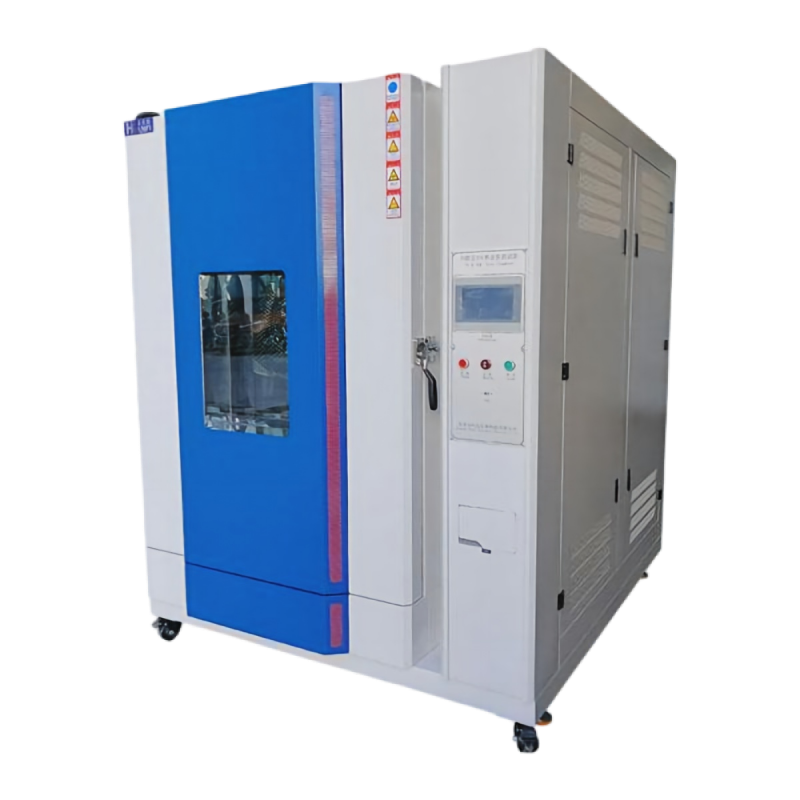
1. Why Chamber Cleanliness Matters
A chamber is designed to measure compounds released by a test specimen under defined environmental conditions. However, if unwanted VOCs remain inside the chamber, the measured concentration may reflect both specimen emissions and background contamination.
Potential contamination sources include:
- Residual compounds from previous tests
- Contaminated chamber surfaces or seals
- Impurities in the incoming air supply
- Contaminated sampling ports, tubing, or fittings
- Cleaning agents that release VOCs
- Contaminated tools or specimen holders
Background contamination can be particularly problematic when testing products with low emission levels. A small background signal may represent a significant proportion of the total measured concentration.
For this reason, laboratories should evaluate chamber background levels rather than assuming that a visually clean chamber is analytically clean.
2. Identify Potential Sources of Contamination
Contamination control should cover the complete sampling pathway, not only the chamber's internal surfaces.
Chamber interior
The chamber's internal materials should be suitable for the intended application and should not introduce unacceptable background emissions under the specified test conditions.
After a test, laboratories should inspect internal surfaces, shelves, specimen holders, and other components that may have come into contact with the test material.
Air supply system
The quality of incoming air can affect background concentrations. Air purification components should be maintained according to the system design, operating conditions, and laboratory procedures.
A stable chamber cannot compensate for contaminated supply air.
Sampling pathway
Sampling ports, connecting lines, fittings, and other components may retain compounds or introduce contamination. The sampling pathway should therefore be included in the laboratory's inspection and maintenance plan.
Cleaning materials
Cleaning products may themselves release volatile compounds. Laboratories should use cleaning procedures and materials that are appropriate for VOC testing and verify that the cleaning process does not create unacceptable background signals.
3. Establish a Repeatable Cleaning Procedure
A written procedure helps operators clean the chamber consistently and reduces variation between tests.
A practical procedure may include the following steps:
(1) Remove the previous specimen and any removable accessories.
(2) Inspect the chamber interior and specimen-contact components.
(3) Clean the designated surfaces using the laboratory-approved procedure.
(4) Inspect sampling ports, fittings, and accessible air-path components.
(5) Operate the chamber under the prescribed conditioning conditions.
(6) Evaluate background concentrations when required by the test method or quality system.
(7) Record the cleaning, conditioning, and background-check results.
The exact cleaning agents, contact times, conditioning duration, and acceptance criteria should be established according to the chamber design, applicable test method, and laboratory validation data. A universal cleaning recipe should not be applied to every chamber or specimen type.
4. Conditioning Before the Next Test
Cleaning and conditioning are related but different activities.
Cleaning aims to remove residues and contamination. Conditioning allows the chamber and its associated systems to return to a suitable state before testing resumes.
Depending on the test procedure, conditioning may involve operating the chamber with clean supply air under defined conditions and checking whether background concentrations have reached the laboratory's established acceptance level.
The required duration should not be determined solely by a fixed number of hours. It may depend on previous specimens, the compounds involved, chamber materials, airflow, and observed background results.
If background concentrations remain unacceptable, the laboratory should investigate the source rather than automatically proceeding with the next test.
5. Verify Background Performance
Background checks provide evidence that the chamber system is suitable for the intended measurement.
The laboratory should define:
· Which compounds or compound groups are monitored
· When background checks are required
· How samples are collected and analyzed
· What acceptance criteria apply
· What action is taken when a result fails the criteria
Background results should be evaluated using the applicable test method and the laboratory's documented quality procedures.
It is also useful to track background data over time. A gradual increase may indicate deterioration of an air-cleaning component, contamination of the sampling pathway, or changes in operating practice.
6. Maintain Cleaning and Maintenance Records
A chamber log supports traceability and troubleshooting. Records may include cleaning dates, cleaning agents, operator identification, conditioning conditions, background measurements, maintenance activities, and corrective actions.
When an unexpected VOC peak appears, these records can help determine whether the signal may be associated with the specimen, the chamber, the supply air, or the sampling system.
Conclusion
Voc Emission Chamber cleaning is not simply a housekeeping task. It is part of the measurement process.
A well-designed contamination-control program combines suitable chamber materials, clean supply air, controlled cleaning procedures, adequate conditioning, background verification, and complete records. Together, these practices help laboratories identify contamination risks and improve the consistency of VOC emission testing.
When selecting a VOC emission test chamber, laboratories should consider not only environmental control performance but also ease of cleaning, sampling-system design, background verification, and maintenance requirements.